The Invisible Signature: How America's Most Refined Individuals Are Transforming Home Fragrance Into a Defining Art
There is a moment, familiar to anyone who has entered a truly exceptional home, that precedes all others. Before the eye registers the proportions of a room, before the mind catalogues the provenance of the furnishings, before conversation begins—there is the scent. It arrives without announcement, settles without permission, and lingers long after departure. For a growing number of America's most deliberate and accomplished individuals, this invisible first impression has become the most carefully considered element of domestic life.
Home fragrance, long consigned to the realm of decorative afterthought—a candle purchased on impulse, a reed diffuser selected for its packaging—has undergone a quiet but profound transformation among the nation's most discerning households. What was once peripheral is now, for those who think deeply about how they inhabit the world, absolutely central.
The Nose Knows: Scent as Architectural Element
The comparison to architecture is not accidental. Those working at the intersection of luxury interior design and olfactory experience increasingly describe scent as a structural element of a home's identity—as load-bearing, in its way, as any wall or threshold. "A room without a considered fragrance is an incomplete room," says one New York-based interior consultant whose client roster spans private estates from the Hamptons to Aspen. "We spend years selecting materials, sourcing art, engineering light. And then we ignore the one sense that bypasses rational thought entirely."
The science behind this intuition is well-established. Olfactory stimuli travel a more direct neurological path than sight or sound, connecting immediately to the limbic system—the seat of memory, emotion, and instinctive response. The implications for the design of experiential space are considerable. A home that smells extraordinary does not merely please; it imprints. It establishes, on a level beneath conscious awareness, a sense of identity that no artwork or fabric can replicate.
This understanding has prompted a meaningful shift among America's most thoughtful homeowners. Rather than selecting fragrance as a finishing touch, they are now incorporating it into the design process from the outset—working alongside architects and interior designers to develop olfactory profiles that complement the spatial and aesthetic logic of each room.
The Private Perfumer: Commissioning Scent as Personal Legacy
At the apex of this movement sits the commissioned fragrance—a bespoke creation developed in collaboration with an independent perfumer or one of a small number of elite fragrance houses willing to work privately with individual clients. The process, which can span months and require dozens of iterations, is less transaction than genuine creative partnership.
Several of the country's most accomplished collectors and executives have quietly engaged perfumers from the established traditions of Grasse, France—the historic capital of fine perfumery—to develop signature scents that exist nowhere else on earth. Others have worked with a new generation of American independent perfumers whose approach blends rigorous naturalism with contemporary sensibility. The result, in either case, is a fragrance that belongs entirely and exclusively to one household.
The investment is substantial—commissions of this nature routinely begin in the tens of thousands of dollars and ascend considerably from there—but among those who pursue it, the logic is straightforward. If one commissions bespoke clothing, bespoke furniture, and bespoke architecture, why should the olfactory identity of one's home be any less singular?
Some take this further still. Fragrance has begun to function, for a rarefied few, as a dimension of personal branding—an invisible signature extended beyond the home into hospitality contexts, private offices, and even personal correspondence through custom-scented stationery and packaging. The scent becomes, in effect, a calling card that precedes and outlasts its owner.
The Fragrance Cellar: Collecting Scent With the Seriousness of Wine
For those whose engagement with the olfactory arts extends beyond the domestic and into the curatorial, the fragrance collection has emerged as a serious pursuit in its own right. Much as the finest wine cellars represent decades of discernment—rare vintages, discontinued expressions, bottles acquired from private estates—the fragrance collections now assembled by certain American connoisseurs reflect an equivalent depth of knowledge and commitment.
Discontinued masterworks from historic perfume houses. Limited editions produced in quantities of fewer than one hundred bottles. Attars—traditional concentrated perfume oils from the Middle East and South Asia—sourced from centuries-old family distilleries. Raw aromatic materials of extraordinary quality: aged Indian oud, vintage Mysore sandalwood, natural absolutes that have become nearly impossible to obtain as supply chains for precious botanical ingredients have narrowed.
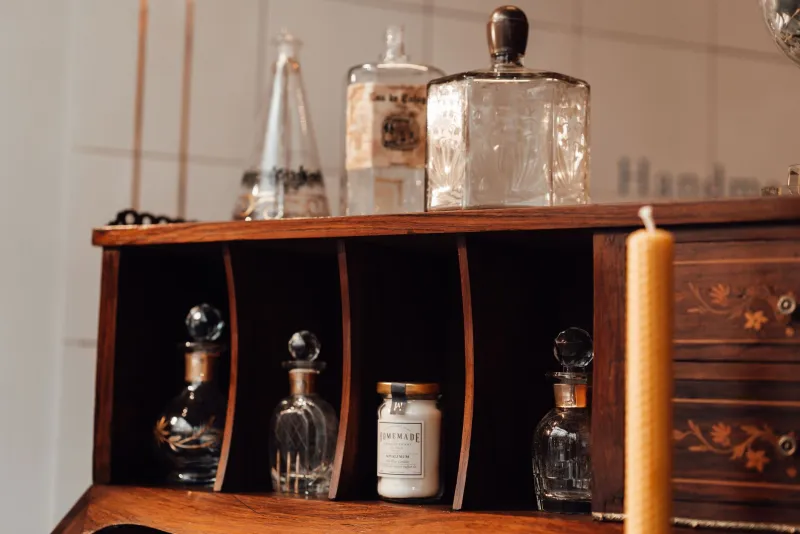
These collections are stored with the same environmental care afforded to fine wine or rare spirits—temperature-controlled, light-protected, catalogued with meticulous attention to provenance. Several collectors have commissioned custom cabinetry specifically designed for fragrance storage and display, transforming what might otherwise be a private obsession into an object of genuine aesthetic beauty.
The community that has formed around this pursuit is small, self-selecting, and deeply knowledgeable. Private exchanges, discreet online forums, and occasional in-person gatherings connect collectors across the country, facilitating the kind of conversation—technical, historical, deeply personal—that serious connoisseurship in any field tends to generate.
The Architecture of Scent: Designing for Every Room
For those who approach fragrance with genuine sophistication, the idea of a single scent pervading an entire home is as artistically unsatisfying as painting every room the same color. The most considered approach involves what practitioners describe as a "scent map"—a deliberate, room-by-room olfactory program that responds to the function, mood, and materiality of each space.
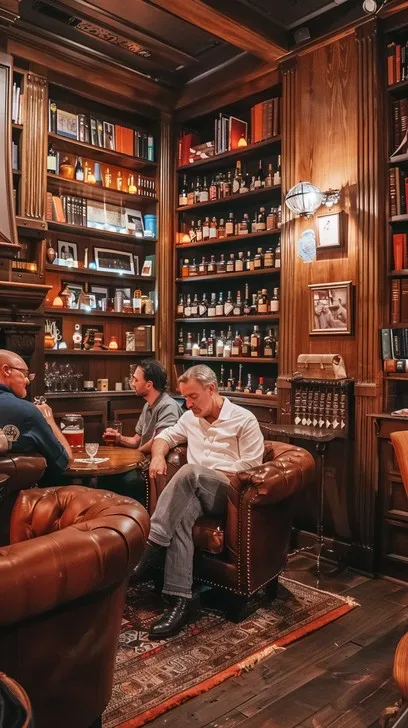
An entrance hall might carry a cool, mineral quality—vetiver, perhaps, or a restrained green note—that creates a sense of arrival and transition. A library calls for depth and warmth: leather, aged wood, a whisper of tobacco or amber. A primary bedroom demands something intimate and enveloping, while a kitchen benefits from freshness without sweetness. Outdoor terraces and garden rooms present their own distinct possibilities, where fragrance can be made to echo or counterpoint the natural scents of the landscape beyond.
The delivery mechanisms for these effects have themselves become objects of design consideration. High-end HVAC-integrated scent diffusion systems—devices capable of dispersing fragrance with extraordinary precision and consistency throughout a space—have found a devoted following among those for whom the candle, however beautiful, represents an imprecise instrument. Others favor the ritual dimension of the candle or incense precisely because it introduces a temporal quality: the scent that marks the evening hour, the ceremony of lighting that signals a transition in the day.
The Understated Luxury
What distinguishes the most accomplished practitioners of olfactory design from the merely enthusiastic is, as in so many domains of genuine refinement, restraint. The goal is never to overwhelm or to announce. It is, rather, to create an atmosphere so perfectly calibrated that the fragrance registers not as a thing added to a space but as an intrinsic quality of it—as though the rooms themselves have always smelled precisely this way.
This is the paradox at the heart of the finest home fragrance: its success is measured by invisibility. The guest who cannot quite articulate why they feel so immediately at ease, so inexplicably at home, so certain that something here is exceptional—that guest has encountered a master of the form.
In a culture that has grown increasingly sophisticated in its appreciation of food, wine, art, and design, scent represents perhaps the last great frontier of domestic refinement. Those who have arrived there first are, characteristically, not speaking loudly about it. They do not need to. The rooms speak for themselves—or rather, they breathe.