First Impressions, Forever: How America's Most Visionary Homes Are Turning Entryways Into Architectural Masterpieces
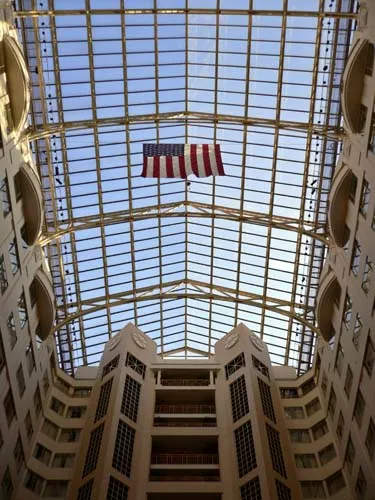
Photo: Dcjohn, CC BY 2.0, via Wikimedia Commons
The foyer has long been regarded as a home's handshake — a brief, functional gesture before the real experience begins. Today, however, America's most discerning homeowners and the architects they trust are transforming these transitional spaces into bold declarations of identity, artistry, and personal philosophy. What was once a coat closet and a welcome mat has become, in the most rarefied circles, a gallery, a statement, and a carefully composed world unto itself.
This evolution is not merely aesthetic. It is deeply psychological, socially conscious, and — whether homeowners acknowledge it openly or not — profoundly shaped by the visual grammar of the digital age.
The Psychology of the Grand Entrance
Human beings have always understood the power of thresholds. From the columned porticos of Gilded Age Newport mansions to the lacquered double doors of pre-war Park Avenue co-ops, the entrance to a private residence has historically communicated status, taste, and intention before a single word is exchanged.
What has changed in the contemporary moment is the audience. Where a Georgian estate once impressed a carefully curated roster of dinner guests, today's luxury entryway may be witnessed — and scrutinized — by thousands. Social media has not cheapened this impulse; if anything, it has sharpened it. The most sophisticated homeowners are acutely aware that their spaces exist simultaneously in physical and digital dimensions, and they are designing accordingly.
"My clients are not designing for Instagram," explains one prominent Los Angeles-based interior designer whose residential portfolio spans Bel Air to the Hamptons. "They are designing for themselves, with full awareness that the world is watching. That distinction matters enormously. The moment a space feels performed rather than lived, it loses its authority."
This tension — between authentic personal expression and the curated self-presentation that social media demands — is precisely what separates genuinely exceptional residential design from mere spectacle.
Materials That Speak Before You Do
At the highest levels of residential architecture, the entryway's material palette is chosen with the deliberateness of a couturier selecting fabric. Honed Calacatta marble floors that absorb afternoon light differently than they do at dusk. Hand-applied Venetian plaster walls in tones that shift subtly with the seasons. Custom bronze hardware whose patina deepens with each passing year.
These are not accidental choices. They are investments in atmosphere — in the precise emotional register a home strikes the moment its door swings open.
New York-based architectural firm Chamberlin & Voss, whose work graces several of Manhattan's most coveted private residences, has noted a marked shift in client priorities over the past several years. "We are seeing a genuine appetite for materiality that photographs beautifully but rewards the physical experience even more," a principal at the firm noted in a recent conversation. "The goal is a space that a photograph cannot fully capture — one that compels you to experience it in person."
This philosophy has given rise to a renewed interest in natural stone, aged metals, and artisanal plasterwork — materials whose inherent imperfection and organic variation resist the flattening effect of a camera lens.
Light as Architecture
Perhaps no single element shapes the character of a luxury entryway more profoundly than light. The most celebrated residential designers in America treat illumination not as a utility but as a structural material in its own right.
Skylit double-height foyers in contemporary Malibu estates cast geometric shadows that migrate across limestone floors throughout the day, creating a living tableau that changes with the hours. In more traditional urban residences — the limestone-fronted townhouses of Chicago's Gold Coast, the Federal-style gems of Georgetown — lanterns and sconces are selected not merely for their decorative merit but for the quality of warmth they lend to a space at the precise moment guests arrive after dark.
The integration of architectural lighting design into the entryway experience has become, for the most serious homeowners, a non-negotiable consideration. "Light is the first thing you feel," observes one San Francisco-based lighting designer whose work spans private residences and boutique hospitality. "Before you register the ceiling height or the artwork or the flowers, your nervous system responds to the quality of the light. That response is what we are engineering."
Art, Object, and the Curated First Glance
For many affluent American homeowners, the entryway has become the most carefully considered room in the house precisely because it is the one space every visitor experiences. It functions, in effect, as a permanent installation — a single, sustained curatorial statement.
The placement of a significant work of art in a residential foyer is nothing new. What is new is the intentionality with which homeowners are approaching this decision. Rather than defaulting to a recognizable name or an impressive scale, the most thoughtful collectors are selecting pieces that establish a genuine dialogue with the architecture — works that reveal something true about the inhabitant rather than simply demonstrating the capacity to acquire.
Objects of personal significance — a sculptor's maquette collected during a formative year abroad, a ceramic vessel by an artist known to only the most dedicated cognoscenti — carry a weight that no amount of auction-house provenance can manufacture. In the most distinguished American homes, the entryway whispers rather than shouts.
The Entryway as Personal Brand
It would be disingenuous to ignore the degree to which residential design at the luxury tier has become intertwined with personal brand construction. For entrepreneurs, creative directors, philanthropists, and public figures, the home is no longer purely a private refuge — it is, in curated glimpses shared through social channels or profiled in shelter publications, an extension of a carefully tended public identity.
The most sophisticated practitioners of this art understand that authenticity is the only currency that holds its value. A home that feels assembled for an audience — however beautifully — ultimately fails the very people it is meant to impress. The entryways that endure in cultural memory, that guests recall years later with genuine feeling, are those that communicate something irreducibly personal.
"The homes I return to in my mind," reflects one veteran design editor who has visited hundreds of distinguished residences across the country, "are the ones where the entrance made me feel I had arrived somewhere specific — somewhere that could only belong to that particular person. That is the standard worth aspiring to."
In the end, the art of the exceptional entryway is not a technical achievement. It is an act of self-knowledge — the courage to distill one's truest sensibilities into stone, light, and space, and to offer that distillation as a genuine welcome to the world.