The New Connoisseurship: How America's Elite Have Made Mastery the Ultimate Measure of Distinction
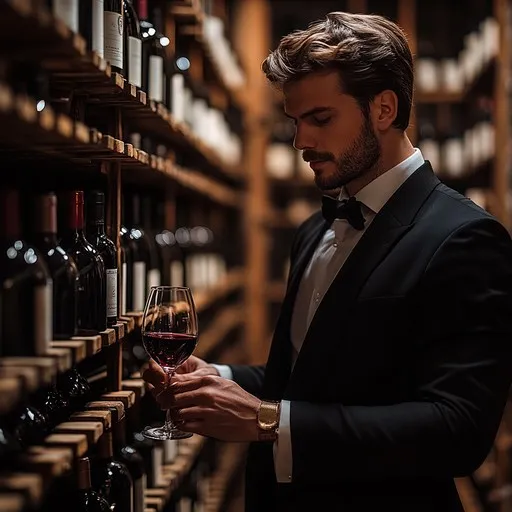
Photo: elegant man examining rare wine bottle in private cellar luxury, via images.stockcake.com
There is a particular moment, familiar to anyone who has attended a certain caliber of private dinner in New York, Napa Valley, or the equestrian estates of Wellington, Florida, when the room falls almost reverently silent. It is not the arrival of a rare bottle or the unveiling of a commissioned centerpiece that commands this attention. It is, rather, the voice of someone who simply knows—who can speak with unhurried authority about the precise terroir of a 2009 Domaine de la Romanée-Conti, or describe the biomechanical nuance that separates a competent dressage rider from a truly accomplished one. In the most discerning American social circles, that voice has become the most coveted presence in any room.
The era of conspicuous consumption, long the dominant grammar of American wealth, is undergoing a quiet but decisive revision. Among the ultra-affluent, the calculus of status has shifted from the accumulation of remarkable objects toward the cultivation of remarkable understanding. What one commands in conversation—the breadth and granularity of one's expertise—has become the new measure by which sophisticated peers assess one another.
From Possessing to Understanding
For decades, the architecture of American luxury was legible primarily through acquisition. The estate, the yacht, the private aviation arrangement—these were the reliable shorthand of exceptional financial standing. And while such possessions have not disappeared from the landscape of affluent American life, they have quietly ceded their role as the primary social signal. Among those who move in the most refined circles, ownership alone is no longer sufficient. It is the understanding behind the ownership that commands genuine respect.
Consider the world of rare wine. The serious collector of a generation ago might have been satisfied to possess a cellar of extraordinary provenance and the sommelier to manage it. Today's most admired collectors have gone considerably further. They travel to Burgundy not as tourists but as students, developing relationships with négociants and vignerons that span years, sometimes decades. They speak with precision about vintage variation, about the particular challenges of a late-frost growing season, about the philosophical differences between natural and conventional winemaking. Their cellars are not merely impressive—they are argued, the product of an intellectual framework that reveals itself in every selection.
This same phenomenon is visible across an astonishing range of pursuits. In the private golf clubs of Augusta, Pebble Beach, and Shinnecock Hills, the most admired members are not necessarily those who play the most expensive equipment but those who have committed to the long, humbling discipline of a scratch or near-scratch handicap. The pursuit of a genuinely elite golf game—one measured in years of technical refinement and mental fortitude—has become a form of credentialing among certain affluent men and women who might otherwise have little patience for prolonged difficulty.
The Equestrian Standard
Perhaps nowhere is this shift more visible than in the world of competitive equestrian sport. The Palm Beach equestrian circuit, the hunter-jumper shows of the Northeast, and the polo grounds of Santa Barbara have long attracted wealthy American families. But the social distinction once conferred simply by participation—by owning quality horses and presenting well—has given way to something far more demanding. The individuals who command genuine admiration today are those who have subjected themselves to the rigorous, often unforgiving process of developing actual horsemanship.
Advanced riders who have trained under European masters, who can articulate the principles of classical dressage with the same fluency they bring to a board meeting, occupy a social position that no amount of checkbook sponsorship can replicate. The horse world, perhaps more than any other arena of affluent American life, has always possessed a democratic cruelty: the animal does not respond to net worth. Mastery must be earned in the saddle, one imperfect lesson at a time, and those who have earned it are recognized accordingly.
Communities of Depth
One of the more fascinating social consequences of this shift is the formation of what might be called communities of depth—exclusive circles organized not around shared geography or professional affiliation but around shared levels of expertise in highly specialized pursuits. These are not clubs in the conventional sense. They are informal networks of individuals who have each committed to genuine mastery of a particular discipline and who find in one another an audience capable of appreciating the nuance of what they have learned.
A loosely organized group of serious fly fishermen, each of whom ties their own flies and has fished remote rivers across Montana, Iceland, and Patagonia, will find in their shared afternoons on the water a quality of conversation that no amount of social engineering could manufacture. A circle of collectors devoted to Japanese woodblock prints—who have studied Edo-period printing techniques, who correspond with curators at the Museum of Fine Arts in Boston, who travel to Tokyo for private viewings—inhabits an intellectual world of considerable sophistication that is entirely invisible to those outside it.
This invisibility is, in many respects, the point. The most refined version of this new status economy operates almost entirely below the surface of public life. There are no press releases, no social media performances, no curated photographs of acquisition. There is only the private recognition, exchanged between people who have done the work, that a peer has achieved something genuinely difficult.
The Discipline Behind the Distinction
What unites these varied pursuits—wine, golf, horsemanship, fly fishing, rare prints—is the requirement of sustained, often uncomfortable discipline. Expertise of the kind that commands genuine respect in the most discerning American circles does not arrive quickly or easily. It demands years of study, frequent failure, the willingness to be a student long past the age when most people abandon such humility, and an investment of time that wealth alone cannot accelerate.
This is, in fact, a significant part of the appeal. In a world where money can purchase almost any experience with sufficient speed, the things that resist acceleration acquire a particular prestige. A master-level understanding of Burgundy's grand cru hierarchy, developed over two decades of tasting and study, cannot be delegated or expedited. It must be lived, one bottle and one conversation at a time.
For those who move at the highest levels of American affluent society, this is a distinction that matters enormously. The most admired figures in these circles are not those who arrived most quickly but those who have traveled most deeply—into their chosen discipline, into the community of fellow experts, and into the particular quality of attention that genuine mastery requires.
In the end, the new connoisseurship asks something deceptively simple of those who aspire to it: not that they spend more, but that they care more—with rigor, with patience, and with the kind of devoted, unhurried attention that has always been, in the most meaningful sense, the rarest luxury of all.