The Quiet Opulence: Why America's Most Affluent Are Choosing Discretion as the Definitive Luxury
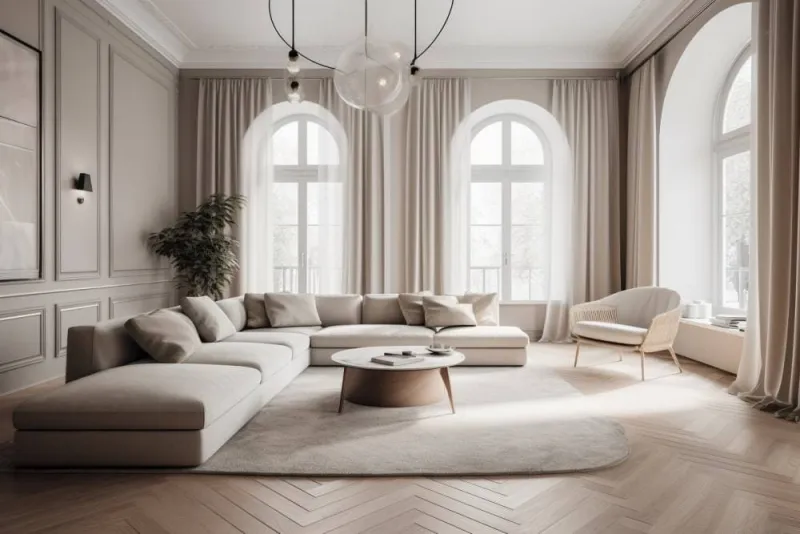
Photo: understated luxury minimalist interior design private residence elegant neutral tones, via www.barnes-bulgaria.com
There exists, within the highest echelons of American wealth, a paradox so elegant it might have been designed. At precisely the moment when popular culture has made the performance of affluence more theatrical than ever—when social media has turned consumption into spectacle and excess into entertainment—the individuals who could most afford that spectacle are quietly, deliberately, turning away from it.
They are not turning toward austerity. The distinction is crucial. What America's most sophisticated ultra-high-net-worth individuals are embracing is something altogether more refined: a form of luxury so complete, so assured, and so deeply considered that it requires no audience whatsoever.
The Aesthetic of Restraint
To understand this shift, one must first appreciate what it is not. The move toward discretion among the truly wealthy is not minimalism in the architectural or philosophical sense—it is not the studied absence of things. Nor is it a retreat from quality; on the contrary, the objects, spaces, and experiences in question frequently represent the absolute pinnacle of their respective categories.
What has changed is the grammar of display. Where a previous generation of American wealth expressed itself through scale—the largest yacht, the most recognizable logo, the most photographed property—a growing cohort of ultra-affluent individuals now prizes the opposite qualities: refinement over size, provenance over prominence, and the kind of understated perfection that reveals itself only to those with the knowledge to perceive it.
In the world of private aviation, this translates to aircraft whose exteriors are deliberately unremarkable—no custom livery, no ostentatious tail numbers—while their interiors are outfitted with bespoke cabinetry, rare leather, and acoustic engineering of extraordinary sophistication. The experience is extraordinary; the announcement is nil.
Real Estate Without Footprint
Perhaps nowhere is the phenomenon of invisible luxury more architecturally instructive than in the realm of residential real estate. The past several years have seen a marked increase in what industry professionals refer to as "stealth" property acquisitions: transactions conducted through layered legal structures that effectively remove the buyer's name from any public record, and properties whose exteriors offer no clue as to the extraordinary spaces within.
In neighborhoods from Pacific Heights in San Francisco to the quieter precincts of Manhattan's Upper East Side, residences of extraordinary refinement sit behind facades of deliberate modesty. The interiors—designed by architects whose names appear on no public-facing portfolio—may contain custom plasterwork of museum quality, stone sourced from quarries that supply the world's finest hotels, and lighting systems programmed with the nuance of a cinematographer's eye. None of this is visible from the street. That, precisely, is the point.
The architectural language employed in these spaces tends toward the timeless rather than the fashionable. Materials are selected for their intrinsic quality and longevity rather than their moment's cachet. A paneled library in quarter-sawn white oak, a kitchen of absolute functional perfection fitted in unadorned stainless and stone, a master suite whose proportions have been calibrated with the care of a couture atelier—these are spaces designed to be lived in with intensity, not photographed for admiration.
The Invisible Collection
The art world offers one of the most illuminating windows into the psychology of discreet wealth. While auction records and gallery openings continue to generate their customary publicity, a significant and growing portion of the most significant art transactions in the United States now occurs entirely outside public view.
Private sales, conducted through intermediaries whose discretion is their principal professional asset, allow collectors of the highest caliber to acquire works of extraordinary significance without triggering the speculation, attention, and security concerns that public acquisition inevitably invites. The work arrives. It is installed in a private residence or a climate-controlled storage facility of institutional quality. It is experienced, studied, and enjoyed by its owner and a small circle of trusted intimates. It does not appear in any catalogue raisonné update. It simply exists, in exquisite privacy.
For many of these collectors, the anonymity is not merely practical but philosophical. The relationship between collector and work, they argue, is fundamentally altered by publicity—compromised by the social performance that public ownership demands. To possess something extraordinary in private is to possess it more completely.
The Psychology of the Unmarked
What drives this orientation toward invisibility? The cultural and psychological motivations are several, and they are not entirely distinct from one another.
Security concerns, in an era of heightened awareness around high-net-worth individuals and their families, play a meaningful role. The conspicuous display of wealth is, among other things, an advertisement for vulnerability. The quiet life is also, in a practical sense, the safer one.
But the motivations run deeper than prudence. There is, among the most accomplished members of this cohort, a quality of confidence so thoroughgoing that it has rendered external validation not merely unnecessary but faintly distasteful. The individual who has genuinely arrived—who has built, created, or stewarded something of lasting significance—has no need of the world's recognition. The recognition that matters is internal, and it is satisfied by the quality of one's choices rather than their visibility.
There is also, undeniably, a social dimension. Within the tight-knit networks of the ultra-affluent, the ability to identify invisible quality—to recognize the unmarked aircraft, the quietly extraordinary residence, the anonymous acquisition—has itself become a marker of belonging. It is a connoisseurship of discretion, a fluency available only to those sufficiently immersed in the culture to have acquired it.
The New Vocabulary of Aspiration
For a brand such as Golden Mister, whose editorial mission is the celebration of living exceptionally well, the rise of invisible luxury presents a fascinating editorial and philosophical challenge. How does one document and celebrate that which is, by definition, designed to go unnoticed?
The answer, perhaps, lies in the shift from spectacle to substance—in attending not to the surface of luxury but to its interior logic. The most aspirational life, it turns out, is not the most visible one. It is the most considered: the life in which every object, every space, every experience has been selected with a discernment so refined that the result achieves a kind of perfection that transcends the need for an audience.
This is, in the end, what the truly wealthy have always known and what the rest of us are only now beginning to understand. The finest things do not announce themselves. They simply are—quietly, completely, and without apology—exceptional.