The Contemplative Kitchen: How America's Intellectual Elite Are Reimagining Culinary Spaces as Sanctuaries of Thought
There is a particular kind of silence that descends upon a well-designed kitchen in the early morning hours — a hush that has nothing to do with the absence of sound and everything to do with the presence of intention. It is the silence of a space that has been conceived not for spectacle, but for thought. For a growing cohort of America's most discerning homeowners, this quality of stillness has become the singular ambition of kitchen design, supplanting the gleaming excess that once defined culinary luxury.
The contemporary trophy kitchen — all Viking ranges and marble waterfall islands staged for admiration rather than use — has begun to feel, among certain rarefied circles, like a relic of a less considered era. What is emerging in its place is something altogether more philosophically ambitious: a kitchen designed around the interior life of its inhabitant rather than the impressions of its guests.
Restraint as the Highest Form of Design
The architects and interior designers working at this elevated tier describe a fundamental inversion of priorities. Where the prevailing aesthetic once demanded abundance — of surface area, of equipment, of visual drama — the new paradigm insists upon subtraction. Every element that does not serve a precise and considered purpose is quietly eliminated.
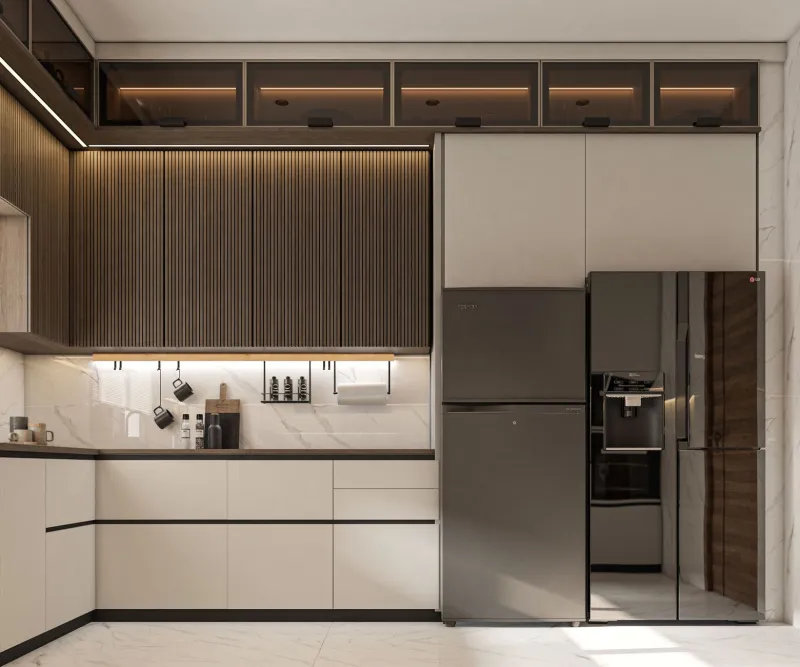
In practice, this translates into kitchens of extraordinary compositional discipline. Cabinetry disappears behind flush panels that read as continuous wall surfaces, their hardware concealed or eliminated entirely. Appliances are integrated with a discretion that borders on the theatrical — refrigeration columns disguised as millwork, induction surfaces flush with stone countertops, ventilation systems so acoustically refined that their operation registers as little more than a whisper. The effect is a room that appears, at first encounter, to be something other than a kitchen — a library, perhaps, or a meditation room that happens to contain a stove.
This is not minimalism for its own sake, designers are careful to note. It is minimalism in service of a specific psychological outcome: the creation of a space in which the mind can settle, and in which the act of preparing food can unfold as something genuinely contemplative.
The Meditative Logic of the Culinary Act
Among the homeowners driving this movement, there is a shared conviction that cooking — when stripped of its performative dimensions — occupies a unique position in the landscape of daily intellectual life. The repetitive, sensory-grounded nature of culinary work: the precise reduction of a sauce, the careful calibration of heat, the patient transformation of raw ingredients into something nourishing — provides what several describe as an irreplaceable counterweight to the abstracted cognitive demands of professional life.
One prominent venture capitalist based in the San Francisco Bay Area, who declined to be identified by name, described commissioning a kitchen renovation with the explicit brief that the space should function as a kind of analog to his meditation practice. "I wanted a room where my hands were occupied and my mind was free," he explained. "Where there was nothing to look at, nothing to manage, nothing to perform for anyone. Just the work itself."
This orientation toward cooking as practice rather than production has material consequences for how these kitchens are equipped. The emphasis falls on hand tools of exceptional quality — Japanese knives maintained with ritualistic attention, copper cookware acquired over years rather than purchased in sets, a single, precisely chosen cutting board of end-grain walnut. Technology is not absent, but it is subordinated to tactile engagement rather than celebrated for its own sophistication.
The Architecture of Hidden Functionality
The engineering challenges involved in achieving this quality of serene functionality are, paradoxically, considerable. The concealment of modern kitchen infrastructure — the plumbing, ventilation, electrical systems, and refrigeration required by contemporary domestic life — demands a level of technical ingenuity that represents some of the most demanding work in residential design.
Leading firms in this space have developed proprietary approaches to storage that prioritize what might be called "cognitive offloading" — the systematic removal of visual complexity from the inhabited surface of the kitchen. Pantry systems are designed with the precision of archival storage, everything categorized and contained behind doors that offer no visual evidence of the abundance within. Countertops, in this philosophy, exist to be clear. Their emptiness is not neglect but intention.
The materials selected for these spaces reinforce their contemplative character. Honed limestone and unfilled travertine, with their quiet geological depth, are preferred over polished marbles that demand attention. Woods are chosen for their grain rather than their rarity, their surfaces finished to invite touch rather than deflect it. Color palettes tend toward the tonal and the muted — the visual equivalent of a room that does not raise its voice.
Technology in Service of Invisibility
If there is a technological dimension to this movement, it operates almost entirely in the negative space — in what it prevents rather than what it enables. Smart home integration in these kitchens is calibrated not to add capability but to remove friction: lighting that adjusts automatically to the quality of natural light, climate systems that maintain precise ambient conditions without manual intervention, audio systems so discreetly installed that music appears to emerge from the architecture itself.
The goal, as one Los Angeles-based designer put it, is a kitchen that "knows what it needs to do and does it without being asked." In this vision, technology is the silent infrastructure of contemplation, handling the mechanical so that the human can attend to the meaningful.
A Room That Reveals Its Owner
What is perhaps most striking about this emerging sensibility is what it discloses about its practitioners. The contemplative kitchen is, by its nature, a deeply personal room — one designed for the solitary morning hours rather than the social evening, for the individual's relationship with nourishment rather than the household's relationship with entertaining. It is, in this sense, among the most autobiographical rooms in the contemporary American home.
To design such a space requires a degree of self-knowledge that is itself a form of achievement — a clarity about one's own rhythms, needs, and values that cannot be purchased ready-made. It demands, as one architect observed, "knowing not just what you want the room to look like, but what you want to feel like inside it."
For the men and women commissioning these spaces, that feeling is, invariably, some version of the same thing: the particular quality of presence that arrives when the noise has been removed, the performance has been abandoned, and what remains is simply a person, a set of ingredients, and the quiet, unhurried work of transformation. In a culture that has made spectacle its default mode, that silence — genuinely achieved — may be the most refined luxury of all.