The Deliberate Room: How America's Most Visionary Leaders Are Engineering Boardrooms for Pure Strategic Clarity
There is a particular kind of room that has begun appearing in the upper echelons of American corporate life — one that announces nothing, displays nothing, and demands nothing of its occupants except their complete and undivided attention. It contains no panoramic vanity walls lined with framed accolades. No gilded fixtures broadcasting the magnitude of quarterly earnings. No monolithic conference tables selected for their capacity to intimidate rather than to inspire. What it contains, instead, is something considerably rarer: silence, intention, and the precise conditions under which consequential thinking becomes possible.
This is the deliberate boardroom — and it represents one of the most quietly significant design movements among America's most accomplished executive class.
The Problem With Power Rooms
For decades, the American boardroom functioned primarily as theater. Its dimensions, materials, and appointments were calibrated less for cognitive productivity than for the performance of institutional authority. Mahogany surfaces projected permanence. Commissioned portraits whispered of lineage. Skyline views through floor-to-ceiling glass reminded every visitor of the altitude at which decisions were being made.
The result, as a growing number of discerning leaders have come to acknowledge, was a space optimized for impression rather than insight. The very elements designed to signal power were, in practice, fragmenting the attention of the people who needed it most. A room built to overwhelm the senses is, almost by definition, a room hostile to deep thought.
"The traditional boardroom was designed to be experienced," observes one Chicago-based organizational consultant who advises Fortune 100 leadership teams on workspace strategy. "What the most sophisticated executives are now asking for is a room designed to disappear."
Acoustic Architecture as Competitive Advantage
The first principle governing these refined new spaces is one that most people have never consciously considered: sound. Or more precisely, the deliberate management of it.
Leading acoustic designers working with executive clients across New York, San Francisco, and Chicago describe a profound shift in how boardroom sound environments are being conceived. Rather than simply dampening ambient noise, these spaces are being engineered with a near-scientific precision — panels of compressed wool felt integrated seamlessly into wall architecture, floating ceiling systems that absorb rather than reflect sound, and door seals calibrated to the standard of a recording studio.
The effect is not silence in its absolute sense, which can itself become disorienting. Rather, it is what specialists describe as acoustic neutrality: an environment in which the human voice carries with perfect clarity, in which the rustle of a single page is audible, and in which the cognitive load imposed by ambient sonic intrusion — the hum of HVAC systems, the distant percussion of an open-plan office — is effectively eliminated.
For executives accustomed to conducting their most consequential conversations against a backdrop of environmental noise, the difference is, by nearly all accounts, immediately perceptible. Thoughts arrive with less friction. Arguments assemble themselves with greater coherence. The mind, relieved of its obligation to filter irrelevant sensory data, becomes available for the work it was summoned to perform.
Material Restraint as Intellectual Statement
Beyond acoustics, the aesthetic language of these spaces represents a deliberate inversion of conventional executive design. Where the traditional boardroom reached for grandeur, these rooms pursue a studied restraint that communicates authority through an entirely different register.
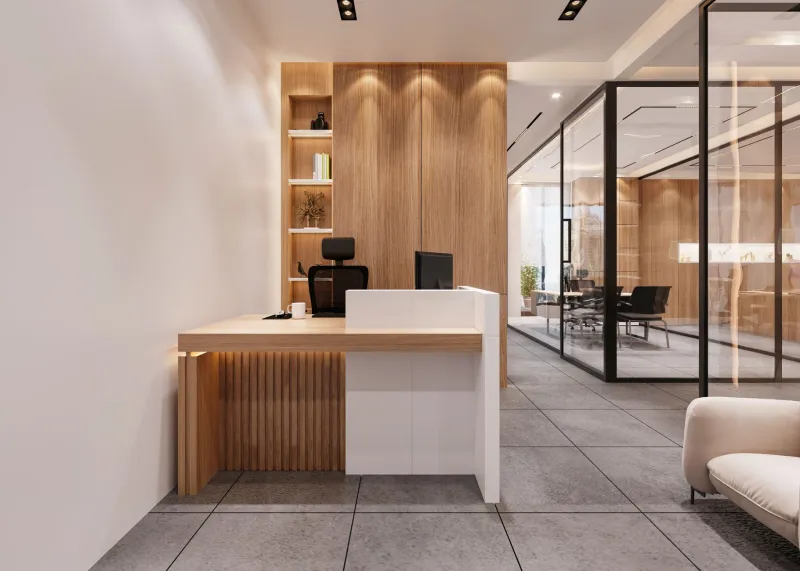
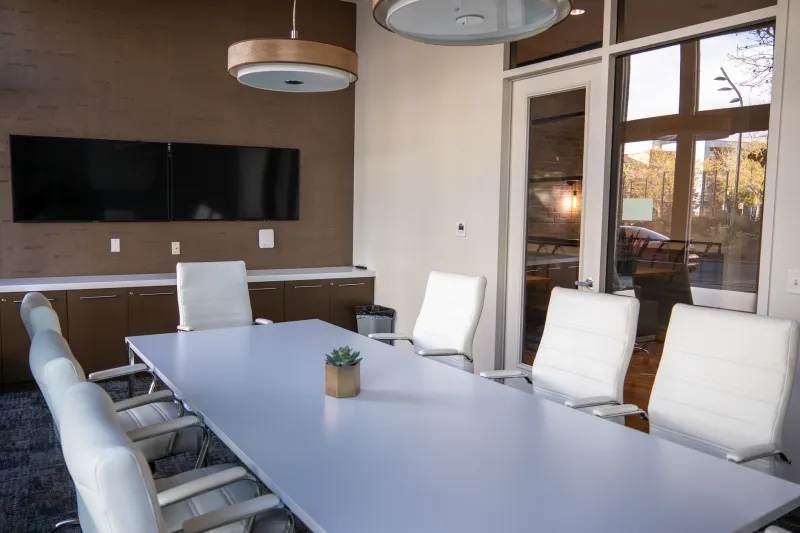
Natural materials — pale limestone, unfinished white oak, matte plaster — replace the lacquered surfaces and polished metals that once dominated corporate interiors. Furniture is selected not for its capacity to impose but for its ergonomic intelligence: chairs that support hours of sustained engagement, tables scaled precisely to the number of people who will use them rather than to the dimensions of the ego that commissioned them.
Color palettes are drawn from the quieter end of the spectrum — warm whites, soft grays, the occasional deliberate note of deep charcoal — chosen not for visual drama but for their demonstrated capacity to reduce cortisol levels and sustain cognitive focus. Lighting systems, often tunable to the precise color temperature most conducive to clear analytical thought, eliminate the harsh overhead fluorescence that has long been the default of corporate America.
The influence of Japanese spatial philosophy is evident throughout, though the finest of these interiors resist any temptation toward literal translation. What they borrow from the Zen tradition is not its aesthetic vocabulary but its underlying logic: that a space stripped of the unnecessary creates the conditions in which the essential becomes visible.
The Deliberate Removal of Status
Perhaps the most counterintuitive dimension of this movement is what it asks executives to surrender. The deliberate boardroom is, among other things, a room from which status symbols have been consciously excised.
The framed photographs with heads of state are absent. The architectural models of flagship properties have been relocated. The custom-commissioned artwork selected to signal cultural sophistication has been replaced, in many cases, by a single work of quiet power — or by nothing at all. Even the technology infrastructure, in the most refined examples, has been rendered invisible: screens that retract flush into walls, connectivity systems that operate without visible hardware, presentation tools that appear only when summoned.
The reasoning is both practical and philosophical. Every object in a room that invites interpretation or admiration is an object that draws the mind away from the conversation at hand. The executive who has genuinely internalized this principle understands that the most powerful statement a boardroom can make is one of complete confidence — a confidence so secure that it requires no external validation whatsoever.
"True authority," as one New York-based interior architect working with senior financial executives puts it, "doesn't decorate itself."
A Sanctuary for the Strategic Mind
What emerges from this convergence of acoustic precision, material restraint, and deliberate simplicity is something that transcends the conventional category of corporate interior design. These rooms function, for the leaders who inhabit them, as something closer to a professional sanctuary — a dedicated environment in which the conditions for genuine strategic thinking have been carefully and intentionally constructed.
In an era defined by the relentless proliferation of digital distraction, the fragmentation of attention across an endless succession of notifications and obligations, the creation of a physical space engineered specifically for depth represents an act of considerable discipline. It is, in the truest sense, a luxury — not because of the cost of the materials employed, but because of the rarity of what it protects.
The most discerning executives in America have recognized something that the broader culture is only beginning to grasp: that the ability to think without interruption, in an environment designed to honor that activity, is among the most valuable assets a leader can cultivate. The deliberate boardroom is how they have chosen to protect it.