Rooms of One's Own: The Affluent American's New Obsession With Intentional Private Space
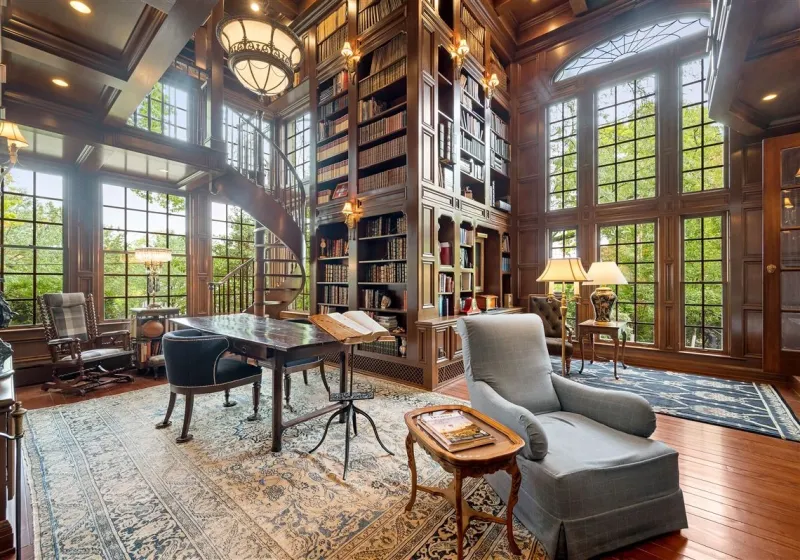
Photo: luxury private library reading room interior design natural light bookshelves, via nolitaharbour.com
There is a particular kind of silence that the most thoughtfully designed homes possess. It is not the silence of emptiness, but of intention—the quiet that arises when a space has been conceived with a singular purpose: to shelter its occupant from the relentless momentum of a consequential life. For America's most affluent homeowners, the pursuit of that silence has become one of the defining architectural endeavors of this decade.
Where previous generations of luxury residential design celebrated the spectacular—soaring entrance galleries, ballrooms engineered for a hundred guests, kitchens that rivaled the finest professional establishments—today's most sophisticated clients are turning their attention inward. The private sanctuary, once an afterthought tucked behind a bedroom closet or relegated to a basement corner, has emerged as the true centerpiece of aspirational home design.
The Architecture of Withdrawal
Leading architects working within the ultra-high-net-worth residential market confirm a marked transformation in client priorities. The request is no longer simply for a home office or a reading nook. It is for an entire ecology of private spaces—rooms that serve distinct emotional and intellectual functions, layered throughout a residence the way a great symphony layers its movements.
A dedicated meditation pavilion, acoustically isolated from the main house and oriented toward a private garden, may sit adjacent to a hand-paneled library stocked with first editions and illuminated by a single north-facing skylight. Nearby, a bespoke recording studio—purpose-built for a client who composes music as a private discipline rather than a public endeavor—might occupy what a lesser designer would have designated as a secondary guest suite. Each room is a declaration: that the interior life merits the same investment as the social one.
Some of the most celebrated residential designers in New York, Los Angeles, and the Mountain West report that these commissions frequently represent the most technically demanding work of their careers. Acoustic engineering, circadian lighting systems calibrated to support mental clarity, air purification technologies borrowed from clinical environments, and bespoke furniture crafted to accommodate extended periods of contemplative stillness—all of these elements must be orchestrated with the same rigor applied to a home's public-facing rooms.
Beyond the Home Theater
The private home theater, long a reliable signifier of affluent residential living, has itself been reimagined. Where the format once implied a replication of the commercial cineplex experience—tiered seating, a large projection wall, perhaps a popcorn machine offered with knowing irony—today's most refined iterations are something closer to a personal screening room in the tradition of the great Hollywood studios.
Seating for eight or ten has given way to custom chaises designed for a single viewer, or perhaps two. Projection technology has advanced to the point where a four-K laser system can deliver an image indistinguishable from film. Sound design, once measured in wattage, is now calibrated by acousticians who treat each room as a unique instrument. The experience is no longer about scale; it is about intimacy, precision, and the particular luxury of encountering art entirely on one's own terms.
Similar refinements have overtaken the private library. Booksellers specializing in curated collections for high-net-worth clients report that the demand is not for impressive volumes arranged by a decorator's eye, but for living libraries—spaces that evolve alongside their owners' intellectual lives, stocked through ongoing relationships with rare book dealers, antiquarians, and subject-matter specialists. The room itself is designed to facilitate serious reading: ergonomic furniture, climate control systems that protect rare bindings, and lighting systems that eliminate glare without sacrificing warmth.
The Wellness Sanctuary Reconsidered
No category of private space has evolved more dramatically than the domestic wellness environment. The home gym, in its earlier incarnations, was essentially a commercial fitness center transplanted into a residential footprint—treadmills facing a television, rubber flooring, mirrored walls. The contemporary iteration bears almost no resemblance to its predecessor.
Today's most thoughtfully designed private wellness spaces function as integrated environments for physical and psychological restoration. A cold plunge pool may be positioned adjacent to an infrared sauna, both overlooking a private courtyard planted with native species chosen for their meditative qualities. A separate movement studio—sprung floors, natural light, a sound system calibrated for both guided practice and personal silence—serves the owner's yoga or martial arts discipline. Some residences now incorporate dedicated breathwork rooms: small, acoustically sealed chambers designed to support extended pranayama sessions or sound healing practices.
Designers note that clients approaching these spaces with the greatest sophistication are those who have engaged deeply with their own needs before the first architectural drawing is produced. They arrive not with a list of amenities, but with a philosophy—a considered understanding of how solitude functions in their lives and what physical environment best supports it.
Solitude as Status
There is a cultural argument embedded in this architectural movement that deserves acknowledgment. In an era defined by connectivity, availability, and the performance of a curated public self, the deliberate cultivation of private space represents a form of resistance—and, for those who can afford to pursue it at the highest level, a form of status that operates on an entirely different register than the conventional signals of affluence.
The most exclusive homes in America no longer announce their owners' wealth primarily through their entertaining capacity. They announce it through the quality of the solitude they make possible. A library where genuine scholarship occurs. A meditation room where authentic stillness is achieved. A studio where private creative work—unshared, uncommercial, answerable to no audience—is pursued with the same resources typically reserved for endeavors that generate admiration.
This is, in the estimation of the architects and designers who work at this level, the most sophisticated form of luxury investment currently available: the construction of a private world calibrated precisely to the interior life of the person who inhabits it. Grand rooms for grand occasions will always have their place. But the room that belongs entirely to oneself—that is where exceptional living now begins.